

If you're wondering does red light therapy affect tattoos, the short answer is no. Current evidence does not show that low-level LED red light therapy fades or alters tattoo pigment in the skin.
That reassurance matters if you're investing in advanced, non-invasive treatments like an FDA-cleared red light mask while also wanting to preserve the integrity of your body art. Understanding the difference between therapeutic light and laser tattoo removal is key.
What this article covers:
- Does Red Light Therapy Affect Tattoos?
- How Tattoo Ink Sits In The Skin
- How Red Light Therapy Interacts With Skin
- Can Red Light Therapy Fade Tattoo Ink Over Time?
- Is Red Light Therapy Safe On Fresh Tattoos?
- Can Red Light Therapy Improve Tattoo Healing?
- Bringing It All Together With Qure
- Frequently Asked Questions
Does Red Light Therapy Affect Tattoos?
There is no clinical evidence that red light therapy fades or removes tattoos. Tattoo removal relies on high-energy, short-pulse lasers specifically engineered to fragment pigment particles.
These systems operate at dramatically higher power densities and are designed to create selective photothermolysis within ink molecules.
Red light therapy, by contrast, uses low-level, non-ablative photobiomodulation wavelengths delivered at regulated energy levels.
Devices designed for home or clinical cosmetic use emit controlled wavelength ranges, typically around 630 to 660 nanometers for visible red light and approximately 830 nanometers for near-infrared. These parameters are selected for cellular stimulation, not pigment destruction.
The mechanism of action is entirely different.
Laser tattoo removal systems deliver concentrated bursts of energy that shatter ink into smaller particles that the immune system can gradually clear.
LED-based red light therapy disperses light across a broad treatment area at consistent output levels that do not generate the thermal shock required to disrupt dermal pigment.
In practical terms, red light therapy is not powerful enough, nor engineered, to break apart tattoo ink.

How Tattoo Ink Sits In The Skin
To understand why red light therapy does not affect tattoos, it helps to revisit how tattoos are structured biologically.
Tattoo ink is deposited into the dermis, the deeper layer of skin beneath the epidermis. This placement is intentional. The epidermis constantly sheds and renews itself, which would cause ink to fade quickly if pigment were placed too superficially.
Once ink is embedded in the dermis, immune cells called macrophages surround the pigment particles. Some of these cells attempt to break down and clear the ink, but the particles are typically too large to be fully eliminated.
Instead, they remain trapped within dermal tissue and immune cells, creating the stable appearance of a permanent tattoo.
How Red Light Therapy Interacts With Skin
Red light therapy works primarily through photobiomodulation. At controlled wavelength ranges, red and near-infrared light penetrate the skin and are absorbed by chromophores within mitochondria, particularly cytochrome c oxidase.
This absorption can:
- Stimulate mitochondrial activity
- Support adenosine triphosphate production
- Encourage collagen synthesis
- Reduce visible inflammation
The therapy is non-ablative. It does not remove layers of skin, vaporize tissue, or selectively target pigment particles. Instead, it supports cellular processes within keratinocytes, fibroblasts, and other skin cells.
Because red light therapy does not selectively bind to tattoo ink or generate sufficient heat to fragment pigment, there is no known mechanism by which it would fade or distort tattoos.

Can Red Light Therapy Fade Tattoo Ink Over Time?
Again, there is no peer-reviewed research demonstrating that red light therapy causes tattoo pigment breakdown, even over a long time.
Tattoo fading is far more commonly associated with ultraviolet exposure. UV radiation penetrates the skin and can gradually degrade pigment molecules, leading to dulling or blurring.
This is why sunscreen is critical for tattoo preservation.
Red light therapy operates at wavelengths different from UV light and does not pose the same photodegradative risk. The absorption spectrum of tattoo pigments does not meaningfully overlap with the therapeutic red wavelengths used in FDA-cleared cosmetic LED devices.
In other words, fading is typically a function of sun exposure, aging, and natural immune processes, not red light therapy.
For individuals managing post-procedure skin, such as red light therapy after Botox, the focus is on inflammation modulation and tissue recovery, not pigment alteration. Tattooed skin behaves similarly once fully healed.
Is Red Light Therapy Safe On Fresh Tattoos?
Fresh tattoos are, biologically speaking, controlled wounds. During the initial healing phase, the skin undergoes inflammation, re-epithelialization, and barrier repair.
There may be scabbing, peeling, and localized swelling.
Introducing any device-based therapy too soon could increase irritation or disrupt healing.
Red light therapy should not be used on a fresh tattoo until the skin barrier is fully restored.
Even though LED devices operate at regulated energy levels, compromised skin is more reactive. During early healing, your priority should be following your tattoo artist's aftercare protocol and maintaining a clean, protected environment.

When It May Be Appropriate
Red light therapy may be appropriate once:
- The tattoo is fully healed
- There is no scabbing or peeling
- The epidermal barrier has normalized
At this stage, healed tattooed skin can generally tolerate non-ablative LED therapy similarly to non-tattooed skin.
Can Red Light Therapy Improve Tattoo Healing?
There is emerging evidence that red light therapy may support aspects of wound healing by modulating inflammation and enhancing cellular energy production.
Controlled wavelength exposure in the red and near-infrared spectrum can stimulate mitochondrial activity and support tissue repair pathways. In theory, this could assist skin recovery once the initial trauma phase has stabilized.
However, red light therapy is not standard tattoo aftercare. Fresh tattoos require meticulous barrier protection, gentle cleansing, and strict avoidance of friction or unnecessary device use.
Once the tattoo is fully healed and the epidermal barrier is restored, photobiomodulation may be considered as part of a broader skin-support strategy. This can be particularly relevant for individuals focused on long-term skin quality surrounding tattooed areas.
It is essential not to extrapolate findings from general wound-healing studies directly to fresh tattoos. Always follow your tattoo artist's and healthcare provider's guidance first.
In short, once healing is complete, FDA-cleared LED devices can be integrated thoughtfully into a non-invasive skincare routine. During the active healing phase, restraint and barrier protection remain the priority.

Bringing It All Together With Qure
Whether your goal is preserving the clarity and vibrancy of existing tattoos or building a comprehensive skin wellness routine, the foundation for beautiful, long-lasting tattoos remains the same: support the biology of your skin without disrupting it.
Red light therapy does not fragment pigment or function like a tattoo removal laser. Instead, it works at the cellular level to support collagen production, mitochondrial efficiency, and visible inflammation balance.
That distinction allows healed tattooed skin to benefit from photobiomodulation without compromising ink integrity.
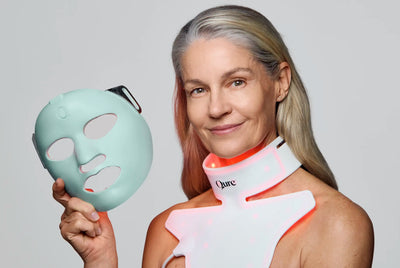
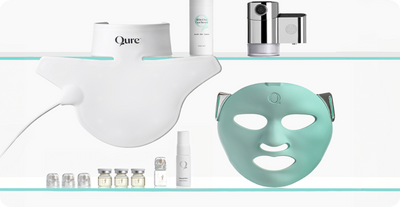
Our FDA-cleared red light mask and red light neck mask are built around safety testing, consistent output, regulated energy levels, and precisely calibrated wavelength delivery for non-ablative skin support.
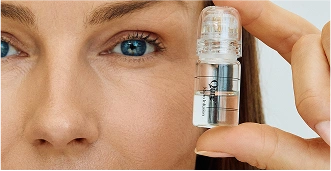
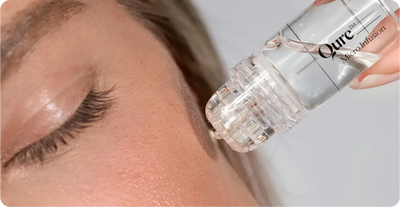
For those looking to enhance overall skin quality, we often pair LED therapy with our anti aging serum to reinforce hydration and collagen-focused care. We also offer the micro infusion facial system for controlled, at-home skin revitalization that respects the integrity of fully healed tattooed areas.
The larger perspective is this: tattoos reside in the dermis, and so does collagen. Because tattoos and collagen both reside in the dermis, maintaining strong, resilient skin is what protects both over time.
Frequently Asked Questions
Can Red Light Therapy Lighten Black Ink?
No. Black tattoo ink is not selectively targeted or fragmented by low-level LED red light. The energy output and mechanism differ entirely from laser tattoo removal systems.
Is Near-Infrared Light Safe For Tattooed Skin?
Near-infrared light used in FDA-cleared devices operates at controlled wavelength ranges and regulated energy levels. On fully healed skin, it is considered non-ablative and does not target dermal pigment.
Will Red Light Therapy Make My Tattoo Blur?
No, there is no evidence that red light therapy causes blurring. Tattoo blurring is more commonly linked to natural aging, immune cell activity, or ultraviolet exposure.
Should I Cover My Tattoo During Red Light Therapy?
If the tattoo is fully healed, covering it is generally unnecessary when using a safety-tested device. If the area is fresh, irritated, or compromised, avoid treatment until healing is complete.
Conclusion
Red light therapy does not function like a tattoo removal laser. The difference lies in intensity, power density, and biological mechanism. Laser systems use high-energy pulses to fragment pigment. LED red light therapy uses controlled wavelength, consistent output, and regulated energy levels to support cellular function without disrupting dermal ink.
For healed tattooed skin, FDA-cleared, non-ablative devices can be part of a thoughtful, non-invasive skincare strategy.
At Qure, tools like our red light mask and red light neck mask are engineered with safety testing and precision-calibrated wavelength delivery to support collagen and skin resilience without targeting pigment.
If you are building a comprehensive regimen, consider pairing LED therapy with the micro infusion facial system or an advanced anti aging serum to enhance overall skin quality around tattooed areas.
Explore Qure's clinically designed, FDA-cleared devices and formulations to elevate your results while preserving what makes your skin uniquely yours.
Read more about targeted skincare:
- Do You Need Eye Protection For Red Light Therapy
- Red Light Therapy Before Or After Tanning
- Red Light Therapy Sunburn
- Red Light Therapy Detox Symptoms
- Red Light Therapy Female Hormones
Most Popular Posts
-
 #Skin
#Skin
What You Eat Can Reduce Premature Aging by...
-
#Skincare
Beauty Sleep Is Real!
-
#LED Light Therapy
Hack your skincare to match your menstrual cycle
-
#Skin
Ice Bath Facial: the affordably cool hack that...
-
#Skincare
5 Ways To Prevent Premature Ageing
-
#Skincare
Glow Up for the Holidays: Radiant Skin Tips...
-
#LED Light Therapy
Shining Light On Sun-Damaged Skin
-
#LED Light Therapy
How LED Therapy Can Transform Your Skin
-
#Skin
How Cortisol Affects the Skin: The Stress-Skin Connection...
-
#Skin
The Hidden Toll of Smoking on Your Skin:...


